
Inbox Zero for Calm Mornings (Not Perfection)
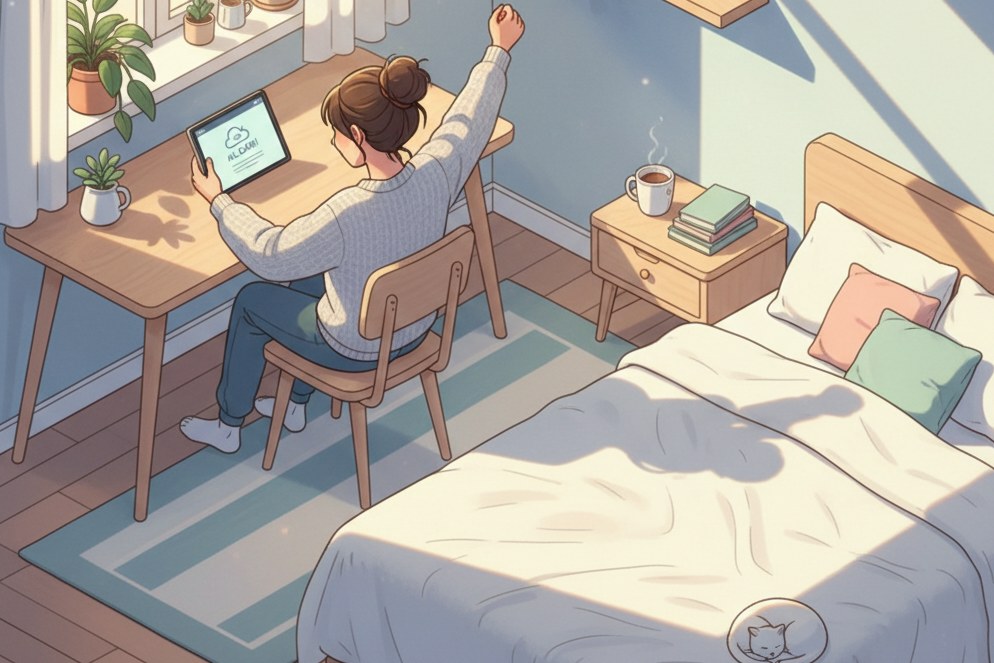
For many people, email isn’t just “messages.”
It’s pressure, responsibility, and the feeling of being behind—before the day even begins.
So let’s make one thing clear from the start:
Inbox Zero isn’t a purity goal. It’s a calmer morning.
This isn’t about proving discipline or keeping an empty inbox forever.
It’s a gentle approach that reduces email anxiety by making the inbox feel manageable, predictable, and kinder to your attention.
1) What Inbox Zero really means (gentle version)
In its simplest form, Inbox Zero is the habit of keeping your inbox from becoming a constant mental burden.
It’s not “I never have emails.”
It’s “My inbox isn’t running my mind.”
A calm version has three principles:
Triage, not perfection (quick decisions, not deep processing)
Tiny routines, not marathons (short sessions that prevent pile-ups)
Boundaries, not availability (email has a place in your day, not all day)
2) Why mornings are where email anxiety grows
Mornings are a sensitive time. Your brain is still “booting up.”
When you open email first, you often invite:
other people’s priorities
unresolved problems
urgent-sounding requests
a sudden sense of debt: “I owe replies.”
That’s not a moral failure. It’s a load issue.
So the goal is simple:
protect the first part of your day from inbox chaos.
3) The calm morning rule: don’t start with email
If you can adopt only one habit, make it this:
Do not open email as your first input.
Even 10 minutes makes a difference.
Try a gentle sequence instead:
water / stretch / breathe
one tiny “self-led” action (review your plan, write one sentence, tidy one surface)
then email—on purpose, not by reflex
This keeps your day anchored in your direction.
4) The “triage” method (5 minutes)
Triage means quick sorting—not solving.
Set a timer for 5 minutes and do only this:
Step A: Delete / archive obvious noise
promotions you won’t read
old threads you’re not part of
notifications you don’t need
Step B: Capture what truly matters (without replying yet)
Move important items into a “Today” list or star them.
The point is to stop them from floating in your mind.
Step C: Identify urgent vs. important
Urgent is time-sensitive.
Important is value-sensitive.
Most anxiety comes from confusing the two.
Triage doesn’t finish email.
It creates a calmer map.
5) A gentle Inbox Zero system (simple folders/labels)
You don’t need a complex setup. A few containers are enough:
Action (This Week) — needs a response or task
Waiting — you replied, now you’re waiting
Read Later — useful, not urgent
Receipts / Admin — reference material
If labels feel like too much, use even simpler:
- Now / Later / Reference
The system should feel lighter than the inbox—not heavier.
6) Tiny routines that keep the inbox from exploding
Inbox Zero works best as a rhythm, not a rescue mission.
Try one of these “calm rhythms”:
Option 1: Two daily email windows
one late morning
one late afternoon
Outside those windows, email is closed.
Option 2: One daily window + one weekly clean
one short daily check (10–20 minutes)
one weekly “reset” session (30–45 minutes)
Option 3: Micro-checks with a hard stop
If your work requires frequent checks, keep them tiny:
3–5 minutes
then stop
then return to your task
The hard stop is the calm part.
7) Boundaries that reduce “inbox guilt”
Email anxiety often comes from an invisible rule:
“I should reply immediately.”
A calmer rule is:
“I reply during my email window.”
“Not everything requires a reply.”
“A short reply is often enough.”
“If it takes more than 2 minutes, I schedule it.”
If it helps, you can also use a gentle template line:
“Thanks—received. I’ll reply properly by (day/time).”
That one sentence can reduce pressure dramatically.
8) What if you can’t reach “zero”?
Then you’re normal.
A calmer version of Inbox Zero allows different success metrics:
fewer anxious checks
fewer open loops in your head
a morning that feels lighter
an inbox that doesn’t control your attention
Sometimes “Inbox Quiet” is a better goal than “Inbox Zero.”
A simple plan you can try tomorrow morning
If you want something concrete:
no email for the first 10 minutes
do a 5-minute triage (delete/archive + mark important)
pick one email to handle fully
schedule your next email window
close the inbox
That’s enough. Calm is built from small endings.
Closing: inbox zero is a feeling, not a number
The point isn’t an empty inbox.
The point is a morning that belongs to you.
Triage gently. Keep routines small. Set calm boundaries.
And let “good enough” be part of the method.
Your attention is worth protecting—especially at the start of the day.